
Bombs Away
If you see a cat strolling through the airport, don’t assume it’s lost. It might be doing the same thing you are, getting on a plane for vacation.
This summer a cat named Harry, was found wandering Boston’s Logan International Airport. For three weeks his humans thought the 8-year-old cat went missing from their Somerville, Mass. home.
“He’s an indoor cat. He doesn’t go out, so he found an escape hatch of some kind,” Harry’s owner, Christine Lafleur, told CBS Boston.
Escape is the correct word to use. Being confined in his home all the time was driving Harry crazy. Watching travel shows all day finally motivated him to break out of stir.
What grabbed Harry’s attention the most was seeing how beautiful Hawaii is.
When everyone was out of the house, Harry booked roundtrip economy class tickets to Maui. When you’re a cat, there’s plenty of legroom in coach.
With all the service animals traveling on planes these days, no one thought it strange that a cat was sleeping on seat 36A.
Maui wasn’t Harry’s finial destination. He was heading to Kahoʻolawe island, about seven miles south.
Cats refer to Kahoʻolawe as the bomb, literally and figuratively. That’s because the 45-square-mile island was once used as a live-fire area and training ground by U.S. armed forces.
Kahoʻolawe is considered a sacred place to native Hawaiians, so naturally it was deemed a good place to conduct target practice following the attack on Pearl Harbor. The bang-bang went on until 1990. The Navy then conducted the Kahoʻolawe UXO (unexploded ordnance) Clearance Project that removed all the bombs, missiles, torpedos and anything else that went boom from 75% of the island.
The other 25%? Party time!
Harry bribed a Maui fisherman to bring him to Kahoʻolawe for some adventures.
500 to 600 cats call Kahoʻolawe home and they’re known for their Hawaiian hospitality. Kahoʻolawe is a 2024 Forbes Travel Guide Star Award winner.
“While white sand beaches, turquoise waters and unexploded munitions are de rigueur at Kahoʻolawe, the reality might even be more spectacular than the photos and explosions filling your social media feed,” gushes Forbes; a go-to resource for hip cats.

The best time to visit Kahoʻolawe is six months after a heavy rain. That’s because the island experiences a “mouse bloom”. Mice are the reason felines were brought to Kahoʻolawe by humans in the first place. When there’s a mouse bloom, word travels fast in the cat world, like when surfers rush to Waimea when the big waves swell up.
If mice aren’t satiating enough for the fur balls, there are also plenty of Polynesian rats to pick off. Admit it, there’s nothing better than a bounty of rodents and synthetic catnip to bring a cat to ecstasy.
“Imagine if there were shrimp cocktail plates running all around your yard … after a while, you know, you can’t eat any more,” Paul Higashino, a natural resource specialist with the Department of Land and Natural Resources, told SFGATE.

At that point, no one is thinking about detonating what’s ever buried in the sand.
Additional entertainment includes an island favorite game called Catlateral Damage, not to be confused with the video game where cats knock over stuff. No, this isn’t kitten fun, it’s meant for the big cats. The goal is simple: seek out and deactivate as many live munitions in one hour.
The winner gets a trophy filled with synthetic catnip (the good stuff from the Sinaloa Cartel), and the first choice of fish for dinner.
Others enjoy a good laugh and the camaraderie of their fellow felines.
The losers, well that’s why cats have nine lives. So far no fur ball has used all of those up playing Catlateral Damage. It also explains how cats survived on the island while the military conducted live-fire exercises.

One downside for cats living on the wild side at Kahoʻolawe is rumors that some of them actually get killed. Only humans would be so gullible.
A recent example was the story of Ted the cat of Newby, North Yorkshire, England.
Ted’s humans were on holiday in Türkiye when they got a call their cat had drowned in their pond. The family quickly arranged to have the deceased feline cremated.
“I had to break the news to my husband and our four children and we were all absolutely devastated, because Ted is a huge personality and a beloved member of the family,” Ted’s human mom, Nicci Knight recounted to the BBC.
Four days after the solemn ceremony, Knight, still in Türkiye, was informed that Ted staggered into the house through the cat flap.
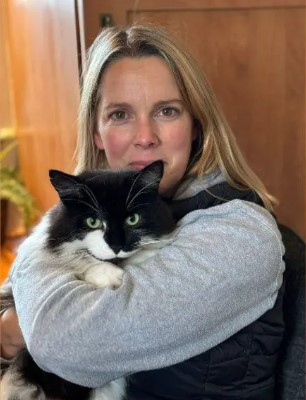
“I didn’t believe it at first,” Knight said. “I had to get her [cat sitter] to FaceTime me live so that I could see that Ted was actually alive.”
Vicki Crallan, the director of Heavenly Pets Crematorium, told the BBC, it was “bittersweet” and [she] was worried there was a family out there “missing somebody”.
Turns out that family wasn’t Ted’s.
When Ted’s humans returned home there was much jubilation that their cat wasn’t deceased.
As they wondered how the mixup happened, Ted was keeping his puss shut, not wanting to tell the Knights that he was frolicking at Kahoʻolawe getting toasted while playing tiptoe through the TNT playing Catlateral Damage.
Ms. Knight went to collect the ashes of the mystery cat which was labeled, “Not Dead Ted.”
“I’ve paid £130 to cremate someone else’s cat,” Knight seighed.
Ted spit out his tuna juice when he heard that.
 The Chester Chronicles